
Updated February 03, 2026 By Lamia Ghernati & Rim El Helou
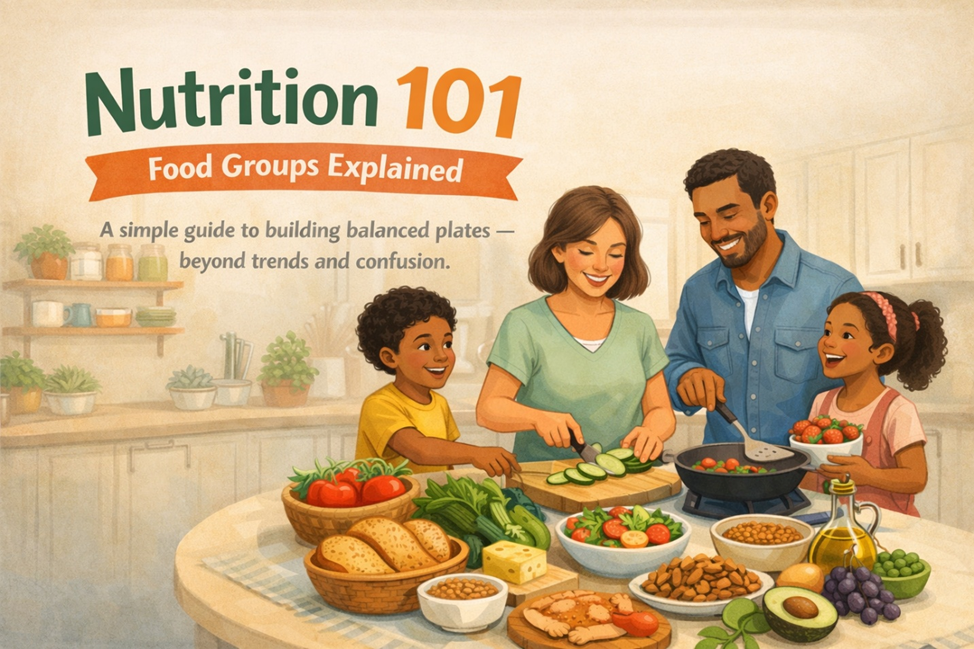
With so many nutrition trends circulating today, the new year is a great opportunity to step back and rebuild a strong foundation based on science, not noise.
Welcome to our Nutrition 101 series — designed to translate nutrition science into everyday understanding. In this first article, we explore why nutrition starts with food groups and patterns, not isolated nutrients, trends, or shortcuts.
🧠 Why Nutrition Advice Feels So Confusing Today
If nutrition feels confusing, you’re not alone.
Everywhere we look, we’re told to eat less of this, more of that, or to completely eliminate certain foods. One day carbohydrates are the enemy. The next, vegetables are “overrated” and protein is presented as the ultimate solution to health.
This constant stream of contradictory advice leaves many parents wondering:
- Am I feeding my family correctly?
- Should I be avoiding entire food groups?
- Why does nutrition feel so complicated?
Part of the confusion comes from the way nutrition is often presented — as isolated nutrients, trends, or rules — instead of as real meals eaten in real life.
When nutrition is reduced to extremes or single “hero” nutrients, it becomes harder to understand and even harder to apply at home.
Nutrition doesn’t need to feel extreme or technical. It needs to feel practical and understandable.
🍽️ We Eat Foods, Not Nutrients
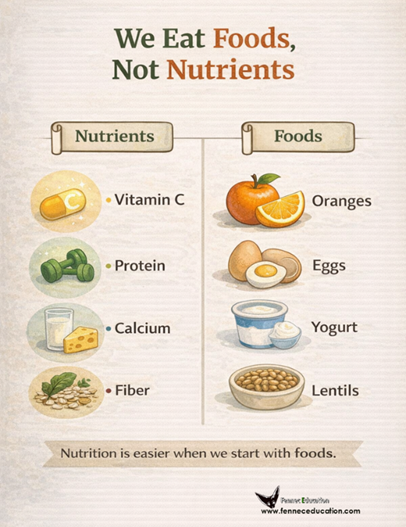
In theory, nutrition is made of nutrients: carbohydrates, proteins, fats, vitamins, and minerals.
But in daily life, we don’t eat nutrients — we eat foods.
We eat bread, rice, vegetables, beans, yogurt, fish, fruit, and olive oil. These foods naturally contain a combination of nutrients that work together in the body.
Focusing only on nutrients can:
- Create unnecessary fear (for example, around carbohydrates or fats),
- Disconnect nutrition from culture and pleasure,
- And make eating feel like a math problem.
That’s why nutrition education — especially in clinical and public health settings — starts with food groups. They help translate science into everyday plates.
This nutrient-focused mindset has also fueled the idea that health can be “optimized” through powders, pills, or single nutrients— sometimes presented as a replacement for real meals. What is often overlooked is that supplements do not enter the body in the form we imagine. For example, collagen supplements are not absorbed as collagen. During digestion, they are broken down into amino acids and small peptides, just like any other protein. The body then decides how to use those building blocks based on its own priorities not our intentions.
While supplements can be useful in specific situations, they don’t replicate the complexity of food. Whole foods work in synergy: fats help absorb fat-soluble vitamins, vitamin C enhances protein and mineral absorption, and proteins naturally come with a full spectrum of amino acids. This is why supplements can support nutrition, but they don’t replace real meals.
Our bodies are designed to process foods, not formulas. A balanced meal made of real foods provides far more than isolated nutrients. It delivers interaction, absorption, and regulation that supplements alone cannot replace.
🧩 What Food Groups Really Represent
Food groups are not arbitrary categories, and they are not rules to follow blindly.
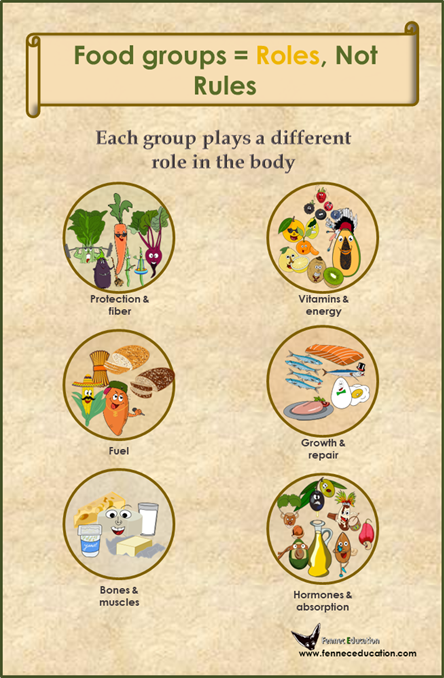
They exist because different foods play different roles in the body.
Each food group provides a specific function:
- Some give energy,
- Some support growth and repair,
- Some protect long-term health,
- Some help regulate digestion, hormones, and metabolism.
The main food groups we use to build balanced meals are:
- Vegetables
- Fruits
- Starchy foods (grains, legumes, starchy vegetables like potatoes and corn)
- Protein foods
- Calcium-rich foods (including dairy and non-dairy sources)
- Fats
None of these groups is optional. Balance comes from combining them, not from eliminating one.
🥗 The Logic of a Balanced Plate
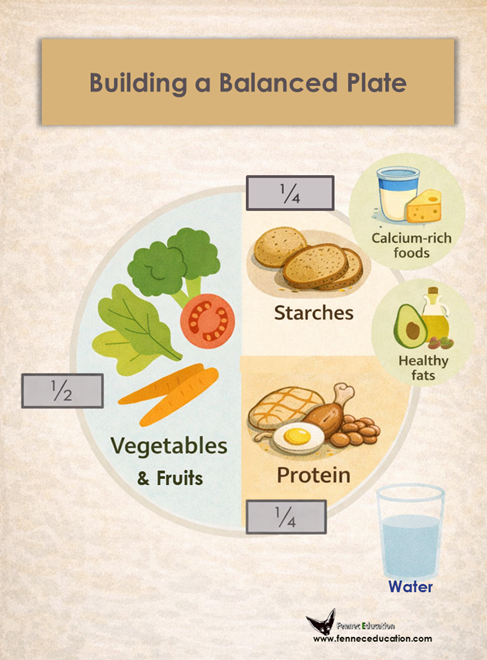
A balanced plate is a visual tool that helps translate nutrition science into something concrete.
Rather than counting nutrients, a plate shows:
- How foods fit together,
- How portions relate to each other,
- How balance supports the body.
In general:
- Vegetables take up a large part of the plate because they provide volume, fiber, and protective nutrients with relatively low energy density.
- Starchy foods supply energy needed for daily activities, growth, and brain function.
- Protein foods support growth, tissue repair, and satiety.
- Calcium-rich foods support bones, muscles, and many metabolic processes.
- Fats, though used in smaller amounts, are essential for hormone production, brain health, and nutrient absorption.
For example, a balanced lunch plate might include roasted vegetables, rice or bread, lentils or chicken, yogurt or a calcium-fortified alternative, and a drizzle of olive oil.
Think of the plate as a team: each food group has a role, and health comes from collaboration — not dominance.
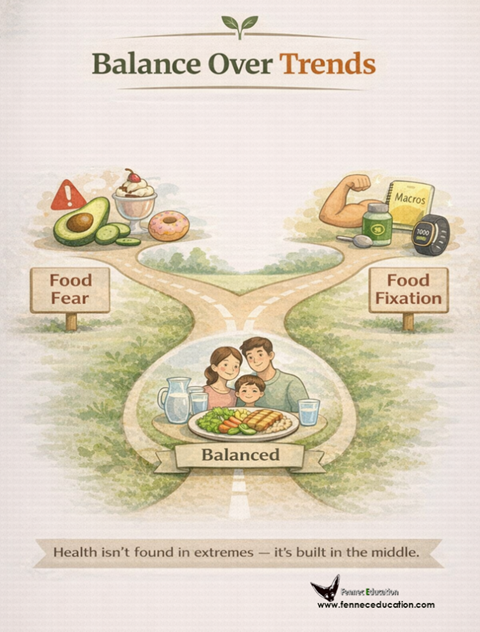
🔄 Why Balance Matters More Than Trends
Most nutrition problems don’t come from eating one specific food.
They come from imbalance over time.
When one food group is consistently missing or overrepresented, the body may struggle with:
- Unstable energy levels,
- Digestive issues,
- Mood fluctuations,
- Or long-term health risks.
Nutrition science consistently shows that:
- Extreme restriction is rarely sustainable,
- Variety supports nutritional adequacy,
- Patterns matter more than single meals.
Balance is not about perfection — it’s about consistency over time.
👨👩👧 Why One Plate Doesn’t Look the Same for Everyone
While food groups remain the same, plates don’t look identical for everyone.
Portions and proportions may change depending on:
- Aage and growth stage,
- Physical activity level,
- Cultural food traditions,
- Personal preferences,
- Or specific health conditions.
This doesn’t mean abandoning the plate model — it means adapting it.
The structure stays the same; the details evolve.
🌱 A Preview of What Comes Next
Now that the logic of food groups and balanced plates is clear, the next articles in this series will explore each group in more detail.
We’ll look at:
- The difference between starchy and non-starchy foods,
- Why vegetables deserve special attention,
- How plant and animal proteins differ,
- Where to find calcium beyond dairy,
- And how fats support health when chosen wisely.
Each article will deepen understanding — without losing sight of the plate as a whole.
✨ Final Thought: Food Groups as Tools, Not Labels
Food groups are not rules to fear or trends to follow.
They are tools designed to help families build meals that support health, energy, and well-being.
Rather than changing everything at once, start by noticing which food groups regularly appear on your family’s plates — and which ones are often missing.
When we understand food groups, we stop chasing extremes and start making choices with confidence.
Nutrition becomes less about restriction — and more about knowledge, balance, and trust.